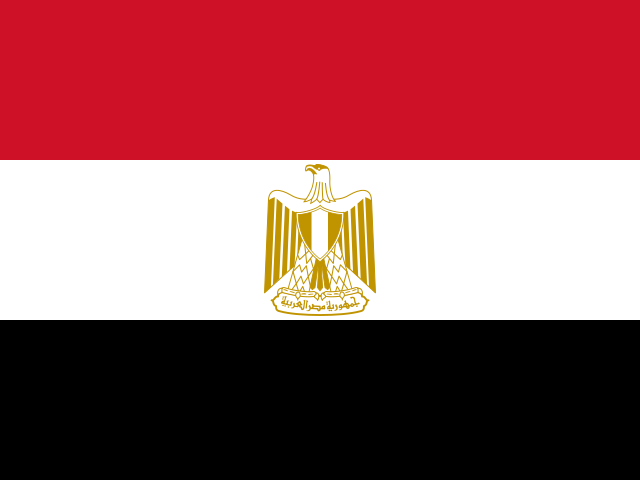
 Egypt
Egypt
UK Foreign Office travel advice · 4 August 2026
Current safety guidance for Egypt from UK Foreign Office travel advice. We cover 2 cities in Egypt, with reported scams for each.
Source: Egypt travel advice — UK Foreign Office travel advice
Contains public sector information licensed under the Open Government Licence v3.0.
The crime rate is generally low, but visitors should take sensible precautions as they would in the UK.
To report a crime, phone the tourist police on 126. If you do not report a crime before you leave Egypt, it will be difficult to prosecute later.
Be cautious in tourist areas, where scammers and touts sometimes target foreign nationals.
Approximately one million British people travel to Egypt each year. Most visits are trouble-free. This guide also has safety advice for regions of Egypt.
There is a high threat of terrorist attack globally affecting UK interests and British nationals, including from groups and individuals who view the UK and British nationals as targets. Stay aware of your surroundings at all times.
UK Counter Terrorism Policing has information and advice on staying safe abroad and what to do in the event of a terrorist attack. Find out more about the global threat from terrorism.
Terrorists are likely to try to carry out attacks in Egypt.
Terrorist attacks could be indiscriminate including in places visited by foreign nationals. Stay aware of your surroundings, keep up to date with local media reports and follow the advice of local authorities. Be vigilant in crowds and large gatherings.
Targets might include:
The authorities in Egypt have a significant security presence across the country. Extra measures are in place at tourist sites.
Examples of recent attacks include:
In 2024, one Israeli-Canadian national was killed in a shooting attack in Alexandria
In 2023, 2 Israeli tourists and an Egyptian tour guide were killed in a shooting attack in Alexandria
In 2022, 4 police officers and one insurgent killed in an attack on a police checkpoint in Ismailiya City
The political environment in Egypt is restrictive. Avoid large gatherings, demonstrations and protests as the situation could change quickly and without warning. Security forces have responded forcefully to protests and disturbances.
Foreign nationals involved in any political activity or activities critical of the government may be at risk of detention. This includes posting negative comments on social media.
A number of sexual assaults have been reported to the British Embassy, including cases involving minors.
The majority of cases that have been reported took place in tourist resorts in the Red Sea region, often committed by someone the victim had already met, including hotel workers and excursion staff. There have also been reports of hotel staff discouraging incidents being reported to local police.
Female travellers should exercise caution when travelling alone, particularly at night, in taxis.
Take extra precautions:
do not leave children unaccompanied
do not allow hotel staff to enter your room when you are alone – try to ensure a friend or relative is present
avoid travelling in a taxi alone – if this is not possible, apply extra security by sharing the details of your driver, trip and live location with a friend
use reputable providers for any services and excursions, and carry out research beforehand
avoid sharing personal contact or social media details
Pickpocketing is rare in Egypt. Take the same precautions as you would in the UK.
It might be helpful to make photocopies of your passport, visa and flight ticket to keep separately from originals when travelling. If your passport is lost or stolen, tell the police immediately and get a police report. You will need a police report to get visa stamps transferred to your replacement passport.
Egypt is predominantly an Islamic country. Take care to respect local traditions, customs, laws and religions. Seek to avoid offence, especially during Ramadan or when you visit religious areas.
It is illegal to encourage people to convert to Christianity or any other religion.
Ramadan is a holy month for Muslims. The dates vary by year and country and you should check this before you travel. During this time, it is culturally insensitive to eat, drink or smoke in public during daylight hours. It is advisable not to play loud music, dance or swear in public.
Get more advice when you arrive from your tour guide, hotel or business contacts.
You should also:
check opening hours of shops and restaurants
be aware that if hotels and restaurants are providing food or drink in fasting hours, they may separate non-fasting guests, for example with screens
follow local dress codes – clothing that does not meet local dress codes may cause more offence at this time
be aware that driving may be erratic, particularly when people are trying to get home at dusk
be patient and show tolerance
Police check ID regularly and will ask to see your passport. They may detain you if you cannot show your ID and your visa (or a digital/paper copy).
Dress modestly, especially in rural areas, mosques and souqs (markets).
Couples showing physical affection in public is frowned upon. Holding hands is generally fine. Behaviour accepted in tourist resort areas may not be accepted elsewhere.
Drinking alcohol anywhere other than licensed restaurants, bars, or private homes or certain tourist resorts is illegal and can lead to arrest.
Possession, use or trafficking of illegal drugs is a serious offence and can, even for small amounts, lead to life imprisonment or the death penalty. People who get a life sentence on drugs charges normally spend the rest of their lives in prison with no chance of parole or a pardon.
Khat is illegal in Egypt.
You must get a permit to enter Egypt with professional photography or film equipment. This includes photography umbrellas, artificial outdoor lighting gear and any equipment that occupies or blocks public roads.
It is illegal to take or share photos that could be considered damaging to the country’s image.
Ministry of Tourism regulations on photography say that you must get an Egyptian citizen’s written permission before you take their photo. Taking pictures of children is prohibited. Do not photograph officials without their consent.
It is illegal to take photos of, or near, military property. This includes the Suez Canal.
If you are in any doubt, get permission before taking photos. There are sensitivities about taking photographs of:
It is illegal to use radio-controlled helicopters or drones to take photos near sensitive sites.
Do not import, use or produce drones in Egypt unless the Egyptian Ministry of Defence gives you permission beforehand. Anyone who uses or imports drones without permission could get a prison sentence of up to 7 years or a fine of 5,000 to 50,000 Egyptian pounds.
Same-sex sexual activity is not explicitly criminalised in Egypt. However, the Egyptian authorities have prosecuted LGBT+ people under ‘debauchery’ laws, including people flying rainbow flags at public events.
There is little public acceptance of same-sex relationships in Egypt. Same-sex couples showing affection in public are likely to receive negative attention.
Be cautious about sharing content or having discussions of a sexual nature on social media, especially about sexual acts that are considered illegal. Some travellers have been arrested and imprisoned for this.
You may be denied entry if your gender expression or physical appearance does not match the sex marker in your passport or your passport photograph.
Read more advice for LGBT+ travellers.
Egyptian family law is very different from UK law, particularly around child custody. See International parental child abduction for information and how to get assistance.
Make sure your travel insurance, or the tour or dive company, will cover the costs for any air or sea rescue, which can cost more than 4,000 US dollars per hour. The Egyptian authorities will only start rescue operations when they are guaranteed payment. Book excursions for activities at your resort or through approved agents or tour operators.
See Foreign travel insurance for more information.
Speak to your tour company before booking a hot air balloon flight. Some UK tour operators have stopped selling balloon flights because they have not been able to verify safety standards.
There have been recent incidents involving British nationals on diving boats/tours in the Red Sea. Some of these have included fatalities. Safety standards of Red Sea resort diving operators and boats vary considerably. Some operators may not provide adequate safety and insurance standards.
The Marine Accident Investigation Branch (an independent investigative unit within the Department for Transport) published guidance about liveaboard vessels on their website in February 2025. They recommend that prospective customers book liveaboard dive holidays only through reputable vendors who can provide assurance about the safety standards applicable to the dive boat. On arrival on board, customers should request that the crew provide a thorough safety briefing before departure.
You should:
Shark attacks are rare, but there have been attacks on tourists in the Red Sea region. Monitor any updates from local authorities or your tour operator.
See watersports safety advice from the Royal Society for the Prevention of Accidents (ROSPA).
There have been several serious quad bike accidents involving British nationals in resort areas. Take the same precautions as you would in the UK. Safety standards vary considerably. Always wear a crash helmet.
If you are planning to drive in Egypt, see information on driving abroad.
You’ll need to have both the 1949 version of the international driving permit (IDP) and your UK driving licence with you in the car. You cannot buy an IDP outside the UK, so get one before you travel.
You can drive in Egypt using your UK licence and an IDP for up to 6 months. If you plan to stay longer, you must apply for an Egyptian driving licence.
Drivers and front seat passengers must wear seatbelts.
Driving under the influence of alcohol or drugs is a serious offence in Egypt. If you are caught, you may get a fine and possible imprisonment.
You may not be allowed to import a vehicle into Egypt. If you want to bring in a vehicle temporarily, you must get a ‘carnet de passage’ from the Automobile Association.
Accidents are common because of variable road conditions, dangerous driving and poor traffic law enforcement. Do not drive outside main cities and resorts at night. Make sure you have appropriate insurance.
If you’re travelling off road, use a qualified guide and get a permit from the Ministry of Interior.
Serious bus crashes in recent years have caused many deaths, including tourists.
There have also been fatal train collisions and derailments.
Overcrowding and poor safety standards have caused accidents on Red Sea ferries and Nile cruises.
This section has safety advice for regions of Egypt. It only covers regions where FCDO has specific advice.
You should also read FCDO’s overall travel advice and safety and security advice.
FCDO advises against all travel to within 20km of the Egypt-Libya border, except for the town of El Salloum, where we advise against all but essential travel. There are active military operations targeting criminal activity in this area.
FCDO advises against all travel to North Sinai Governate due to continuing criminal activity and terrorist attacks on police and security forces that have resulted in deaths. See Terrorism in Egypt.
FCDO advises against all but essential travel to the northern part of South Sinai Governate, beyond the St Catherine-Nuweibaa road, except for the coastal areas along the west and east of the peninsula.
We advise against all but essential travel due to criminal activity and terrorist attacks on police and security forces that have resulted in deaths. See Terrorism.
If you plan to travel in a 4-wheel-drive vehicle from mainland Egypt through the Suez crossing, you must get a permit from Travel Permits Department of the Egyptian Ministry of the Interior. You should book any activities outside of resort areas through approved agents or tour operators.
Travel to Red Sea tourist areas in the southern part of the Sinai Peninsula is generally low risk. Security forces carry out routine checks on vehicles and at airports to protect resorts such as Sharm El Sheikh, Hurghada and Marsa Alam.
FCDO advises against all but essential travel to the parts of the Ismailiyah Governorate which are east of the Suez Canal, due to ongoing military operations against terrorists and criminals. Egyptian authorities at checkpoints may prevent onward travel to this region. See Terrorism.
FCDO advises against all but essential travel to the area west of the Nile Valley and Nile Delta regions due to risks from criminal activity and military operations, except for:
Tourists who enter the Western Desert areas of Bahariya Oasis, Farafra, the White Desert and Black Desert must apply for permits in advance and use an official guide. There is limited phone reception and poor medical facilities. Monitor travel advice and follow guidance from official guides and local authorities.
FCDO advises against all but essential travel on the road between Al Bawiti and Siwa, including the desert areas near the start of the road in Bahariya. The road is closed and there are military checkpoints.
If you travel to the south-west corner of Egypt near the border with Sudan or Libya, you will need a permit from the Ministry of Interior. Bandits and armed groups operate in these areas.
Be extremely cautious in all border areas.
FCDO advises against all but essential travel to the Hala’ib Triangle and Bir Tawil Trapezoid.
The Hala’ib Triangle remains disputed territory between Egypt and Sudan. If you’re in the Hala’ib Triangle and need urgent UK government support, contact the British Embassy in Cairo.
The Bir Tawil Trapezoid is unclaimed by either Egypt or Sudan. If you’re in this area and need urgent UK government support, contact FCDO in the last country you travelled through.
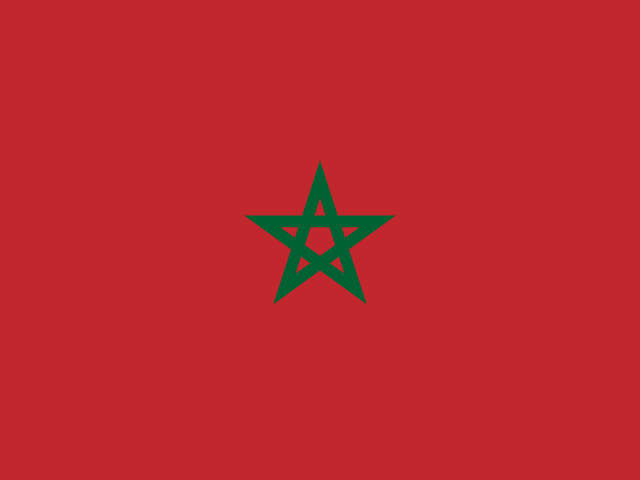 Crime and safety warnings for Morocco
Current safety guidance for Morocco from UK Foreign Office travel advice. We cover 2 cities in Morocco, with reported scams for each.
Crime and safety warnings for Morocco
Current safety guidance for Morocco from UK Foreign Office travel advice. We cover 2 cities in Morocco, with reported scams for each.
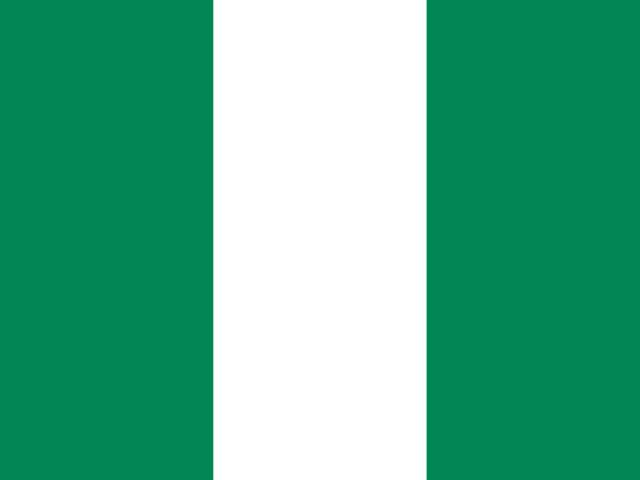 Crime and safety warnings for Nigeria
Current safety guidance for Nigeria from UK Foreign Office travel advice. We cover 1 city in Nigeria, with reported scams for each.
Crime and safety warnings for Nigeria
Current safety guidance for Nigeria from UK Foreign Office travel advice. We cover 1 city in Nigeria, with reported scams for each.
 Panama is at Level 2: exercise increased caution
Current safety guidance for Panama from US State Department travel advisories. We cover 1 city in Panama, with reported scams for each.
Panama is at Level 2: exercise increased caution
Current safety guidance for Panama from US State Department travel advisories. We cover 1 city in Panama, with reported scams for each.
 Crime and safety warnings for Colombia
Current safety guidance for Colombia from UK Foreign Office travel advice. We cover 3 cities in Colombia, with reported scams for each.
Crime and safety warnings for Colombia
Current safety guidance for Colombia from UK Foreign Office travel advice. We cover 3 cities in Colombia, with reported scams for each.
 Crime and safety warnings for Serbia
Current safety guidance for Serbia from UK Foreign Office travel advice. We cover 1 city in Serbia, with reported scams for each.
Crime and safety warnings for Serbia
Current safety guidance for Serbia from UK Foreign Office travel advice. We cover 1 city in Serbia, with reported scams for each.
 Crime and safety warnings for Laos
Current safety guidance for Laos from UK Foreign Office travel advice. We cover 1 city in Laos, with reported scams for each.
Crime and safety warnings for Laos
Current safety guidance for Laos from UK Foreign Office travel advice. We cover 1 city in Laos, with reported scams for each.