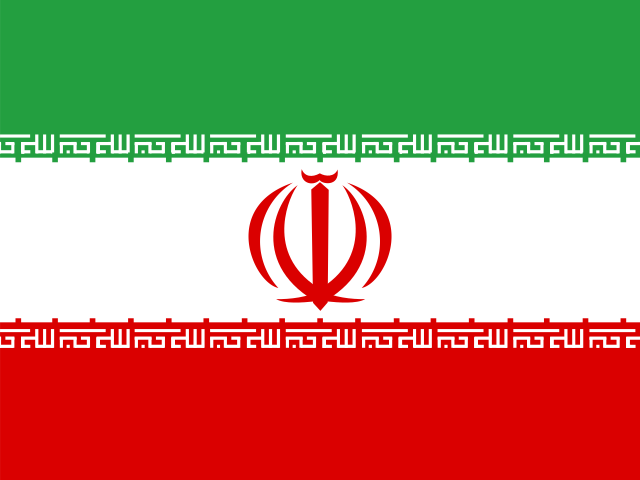
 Iran
Iran
UK Foreign Office travel advice · 22 July 2026
Current safety guidance for Iran from UK Foreign Office travel advice. We cover 1 city in Iran, with reported scams for each.
Source: Iran travel advice — UK Foreign Office travel advice
Contains public sector information licensed under the Open Government Licence v3.0.
Take sensible precautions to protect yourself from street crime and petty theft. Avoid carrying large amounts of money and keep your passport safe.
There have been some attacks and robberies targeted at foreign nationals and tourists, including attempted robberies by thieves posing as policemen, usually in civilian clothing. If you’re approached by anyone who claims to be a policeman, ask to see ID and request the presence of a uniformed officer or marked patrol car. Do not hand over documents or cash, or get into a vehicle.
Getting cash in Iran is extremely difficult. Non-Iranian debit and cash cards will not work in Iran. It’s usually not possible to change travellers cheques.
It’s illegal to change money on the street. You can exchange selected foreign currencies in some exchange offices, though you may have problems changing money. Euros and US dollars are more commonly accepted than British pounds.
Find out before travelling how you will get enough Iranian rials for your visit legally. If you cannot, you may need to reconsider your travel plans.
Motorcycle taxis should not be used as they have sometimes taken tourists to quiet locations and robbed them.
Pre-booked taxis are safer than taxis hailed from the street.
There is a high threat of terrorist attack globally affecting UK interests and British nationals, including from groups and individuals who view the UK and British nationals as targets. Stay aware of your surroundings at all times.
UK Counter Terrorism Policing has information and advice on staying safe abroad and what to do in the event of a terrorist attack. Find out how to reduce your risk from terrorism while abroad.
Terrorists are likely to try to carry out attacks in Iran.
Terrorist attacks could be indiscriminate, including in places frequented by foreign nationals. Stay aware of your surroundings, keep up to date with local media reports and follow the advice of local authorities.
Examples of recent attacks include:
Baluchistan separatist groups have targeted government buildings and infrastructure in the Sistan-Baluchistan region of Iran resulting in casualties.
In an emergency, for example if there is serious violence, unrest or a deterioration in the security situation, the UK government will not be able to evacuate you, provide face-to-face assistance or help you if you get into difficulty. In these situations, it may become more difficult to leave safely. If you are a British national already in Iran, either resident or visitor, carefully consider your presence there and the risks you take by staying.
You should have a contingency plan to leave Iran in an emergency situation. Air, sea and land routes are under the control of the Iranian authorities. You should not assume that ports and borders will remain open if there is a crisis. If your contingency plan involves direct travel to the UK from Iran, you may need to prove to the Iranian authorities that you have the right to enter the UK. You must be able to produce your British passport or a valid UK visa in your Iranian passport on request. You cannot apply for a British passport from Iran.
There is a very high risk of arrest, questioning and detention for British nationals and British-Iranian dual nationals. If the Iranian authorities accuse you of security related offences as a British national in Iran, there is a risk that you will be sentenced to death.
Holding a British passport or having perceived connections to the UK can be reason enough for the Iranian authorities to detain you. If you are detained in Iran, you could face:
British nationals, including British-Iranian dual nationals, and other foreign nationals, have been unfairly detained in Iran. They are often made to serve long prison sentences. In 2023, Iran executed some foreign national detainees, including a British-Iranian national. The criminal justice process in these cases falls below international standards.
If you are detained in Iran, your case will be in the hands of the Iranian authorities, who have demonstrated a pattern of hostility towards the UK and its citizens. If you are a British-Iranian dual national, the UK government will not be notified of your detention, nor will we be given permission to see you. The Iranian authorities will control your access to your family during your detention. If you die in Iranian detention, the Iranian authorities will control the notification process. There is no guarantee the Iranian authorities will inform family members or the UK government.
Iranian authorities have accused people with links to the UK of inciting protests. If you are in or near a protest, you are at serious risk of arrest. Mass arrests, including of bystanders, happen often. It is difficult to predict where protests will take place, and they may turn violent. British nationals arrested in connection with protests may come under increased suspicion of espionage or working to undermine the Iranian authorities. This can increase the risk of lengthy detention, criminal charges or receiving the death penalty.
You may also come under suspicion if you are near sensitive sites, have contact with Iranians who are of interest to the authorities for any reason, or are taking photographs. The Iranian authorities have arrested foreign nationals for possessing photographic equipment near sensitive sites.
Even if you avoid protests and crowds, there is still a very high risk of arrest, questioning and detention in Iran.
Having a British passport or connections to the UK can be reason enough for the authorities to detain you. Some activities put you at even greater risk.
You are at greater risk if you have ever been involved with civil society organisations, including:
Or are involved in other activities such as:
Or are involved with any person or organisation that:
Or you have:
any current or historical links to the State of Israel or Israeli nationals or institutions
any current or historical links to the United States government or public administration
Having a British passport or connections to the UK will put you at increased risk of scrutiny during times of national unrest, following any terrorist incidents, or when there is an increase in tensions between Iran and the international community.
Border areas are highly sensitive. FCDO advises all British nationals already residing in Iran against all travel:
There is risk of banditry in the area east of Bam, Jask, and Sistan and Baluchistan. This is the main route for drug traffickers from Afghanistan and Pakistan. The towns of Zahedan, Zabol and Mirjaveh are particularly insecure.
Some Iranian officials and media reports have falsely alleged a UK connection to anti-government groups in Khuzestan, Kurdish-majority regions, and Sistan and Baluchistan. If you travel to these areas against our advice, stick to the main routes to avoid accidentally entering restricted or military zones.
There have been deaths and cases of serious illness caused by alcoholic drinks containing methanol in Iran.
Even small amounts of methanol can kill. It is not possible to identify methanol in alcoholic drinks by taste or smell. See Travel Aware Drink Spiking and Methanol Poisoning for information about how to reduce the risks.
Seek urgent medical attention if you or someone you are travelling with show the signs of methanol poisoning after drinking.
If you’re visiting Iran to arrange an international surrogacy or adoption, consider the risks and challenges involved. Surrogacy is a complex, lengthy process. You should:
The British Embassy cannot get involved in surrogacy arrangements or recommend hospitals or clinics.
Commissioning a surrogacy will not automatically mean that the child holds British citizenship. To bring your child born through surrogacy from Iran to the UK, you must apply for a full British passport. You need an Iranian birth certificate for this. It’s not possible to apply for a British passport from Iran.
Ramadan is a holy month for Muslims. The dates vary by year and country. During this time, do not eat, drink, smoke or chew gum in public in the daytime, including in your car.
You should also:
Get more advice when you arrive from your tour guide, hotel or business contacts.
Islamic codes of behaviour and dress are strictly enforced. In public places women must cover their heads with a headscarf, wear trousers or a floor-length skirt, and a long-sleeved tunic or coat that reaches to mid-thigh or knee. Men should wear long trousers and long-sleeved shirts in public.
There are extra dress requirements at religious sites. Women may be asked to put on a chador (a garment that covers the whole body except the face) before entering.
The Iranian authorities have arrested, detained and in some cases committed serious acts of violence against women and girls for not properly following dress codes. Enforcement ‘crackdowns’ can lead to large-scale arrests across the country at any time.
Adultery and sex outside marriage are illegal under Iranian law and carry the death penalty.
Relationships between non-Muslim men and Muslim women are illegal, although few westerners have been prosecuted. If a Muslim woman is found in a relationship with a non-Muslim man, she may be sentenced to be whipped.
Unmarried partners and friends of the opposite sex travelling together should be extremely cautious. Sex outside marriage and same-sex relations are against the law in Iran, with the death penalty as the defined punishment.
Iranian hotel managers could insist on seeing a marriage certificate before allowing couples to share a hotel room.
Same-sex relationships are illegal under Iranian law and can carry the death penalty.
Read more advice for LGBT+ travellers.
Women should take extra care, particularly when travelling alone or with friends of the opposite sex. Women face a range of issues, from enforced hijab wearing to harassment due to there being relatively few foreign women in Iran. Respect local customs and avoid isolated areas. See more advice for women travelling abroad.
Many western streaming services including Netflix and Prime are banned in Iran.
It is illegal to import, sell, manufacture or drink alcohol in Iran. This is on religious grounds, with exceptions only for certain recognised Iranian religious minorities. Drinking alcohol in public is not allowed, with no exceptions. Penalties can be severe.
Photography near military and other government installations is strictly prohibited. You can be detained and charged with breaking national security laws. Sensitive government buildings and facilities are often difficult to identify. Take extreme care when taking photographs in any area. The Iranian authorities have arrested foreign nationals for possessing photographic equipment near sensitive sites.
Using a laptop or other electronic equipment in public places can be misinterpreted, especially if your device contains photographs. You may be arrested and detained on serious criminal charges, including espionage.
It’s better to ask before taking photographs of people.
It is illegal to import, sell, manufacture or consume drugs in Iran. Penalties for importing and possessing drugs are severe and enforced. Many people convicted of drug offences, including foreign nationals, have been executed.
You must carry copies of your passport photo page and visa for identification. Make sure you have a copy of the emergency contact details.
You need permission from the Iranian authorities to import or use equipment like drones or satellite phones. Using them without permission is illegal and you could be arrested.
Iranian authorities have blocked, significantly slowed or shut down landline, internet and mobile services without warning in the past. This can be nationwide or localised. This can affect communication and location services on smartphones and other devices. You should:
Individuals involved in commercial disputes with Iranian companies risk being stopped from leaving the country until disputes are resolved.
Representatives of British or western companies may receive particular attention. British businesspeople travelling to Iran against our advice should take steps to protect commercially sensitive information, including password protection of electronic devices and not carrying unnecessary information. Electronic devices may be screened by customs officials on arrival and departure.
See Overseas business risk in Iran for more information.
If you’re planning to drive in Iran, see information on driving abroad.
You must have a 1968 international driving permit (IDP) when using a UK driving licence to drive in Iran. You cannot buy an IDP outside the UK, so get one before you travel.
Iran has a high rate of road accidents. Take great care when travelling by car or public transport and when crossing streets. If you’re involved in an accident, no matter how minor, do not leave the scene. Wait until the police arrive to write their report.
Iranian authorities sometimes set up informal roadblocks both in cities and on main highways. These are often staffed by young and inexperienced officers. Always carry identification with you and avoid getting into disputes.
It is not widely accepted for women to drive motorbikes on public roads and there is a risk of being arrested.
The UK Air Safety List (ASL) lists all known airlines in Iran that do not meet international safety standards and are banned from operating commercial air services to, from, and within the UK. Check the UK Air Safety List when considering which airlines to fly with. The list is maintained by the Department for Transport, based on advice from the UK Civil Aviation Authority.
Many areas of the Caspian Sea, Persian Gulf and Gulf of Oman are very politically and militarily sensitive, with increased military activity including seizures and attempted seizures, boardings and harassment of maritime vessels.
The waters around the islands of Abu Musa and the Tunbs in the southern Persian Gulf are particularly sensitive. British national mariners should not dock or sail into waters around these islands.
When in the region, maintain a high state of awareness and be alert to local and regional tensions which may affect your route. Vessels may be at increased risk of maritime attack and harassment if they operate in the:
Iran has repeatedly attacked commercial vessels in nearby waters with military drones. One attack in 2021 resulted in the deaths of a British and a Romanian national. Vessels have also been seized and their crews detained in and around the Gulf of Oman and the Strait of Hormuz in recent years.
If your vessel is hailed, provide the vessel name, flag state, and confirm they are exercising navigation rights and proceeding in accordance with international law, as reflected in the UNCLOS Convention. You should maintain high levels of awareness when you are operating in the area and report into United Kingdom Maritime Trade Operations (UKMTO). Record footage of all incidents wherever possible.
Find out what you can do to prepare for and respond to extreme weather and natural hazards.
Many parts of Iran are at risk of earthquakes and tremors. These can be high magnitude, cause damage to infrastructure and put lives at risk.
The US Federal Emergency Management Agency website has advice about what to do before, during and after an earthquake.
Some provinces can suffer from floods in spring, particularly:
You should:
 Crime and safety warnings for Morocco
Current safety guidance for Morocco from UK Foreign Office travel advice. We cover 2 cities in Morocco, with reported scams for each.
Crime and safety warnings for Morocco
Current safety guidance for Morocco from UK Foreign Office travel advice. We cover 2 cities in Morocco, with reported scams for each.
 Crime and safety warnings for Nigeria
Current safety guidance for Nigeria from UK Foreign Office travel advice. We cover 1 city in Nigeria, with reported scams for each.
Crime and safety warnings for Nigeria
Current safety guidance for Nigeria from UK Foreign Office travel advice. We cover 1 city in Nigeria, with reported scams for each.
 Panama is at Level 2: exercise increased caution
Current safety guidance for Panama from US State Department travel advisories. We cover 1 city in Panama, with reported scams for each.
Panama is at Level 2: exercise increased caution
Current safety guidance for Panama from US State Department travel advisories. We cover 1 city in Panama, with reported scams for each.
 Crime and safety warnings for Colombia
Current safety guidance for Colombia from UK Foreign Office travel advice. We cover 3 cities in Colombia, with reported scams for each.
Crime and safety warnings for Colombia
Current safety guidance for Colombia from UK Foreign Office travel advice. We cover 3 cities in Colombia, with reported scams for each.
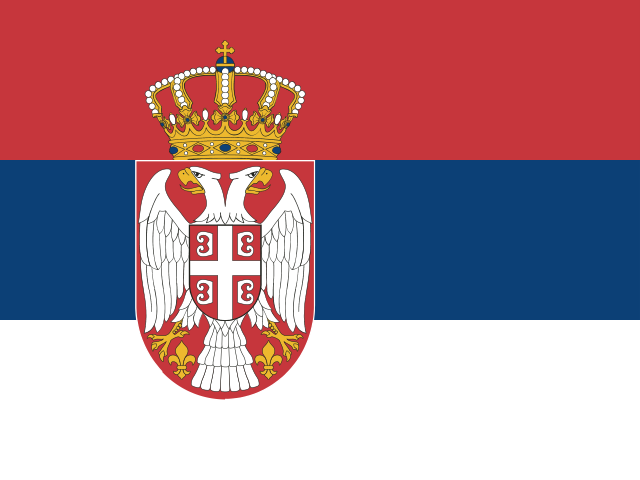 Crime and safety warnings for Serbia
Current safety guidance for Serbia from UK Foreign Office travel advice. We cover 1 city in Serbia, with reported scams for each.
Crime and safety warnings for Serbia
Current safety guidance for Serbia from UK Foreign Office travel advice. We cover 1 city in Serbia, with reported scams for each.
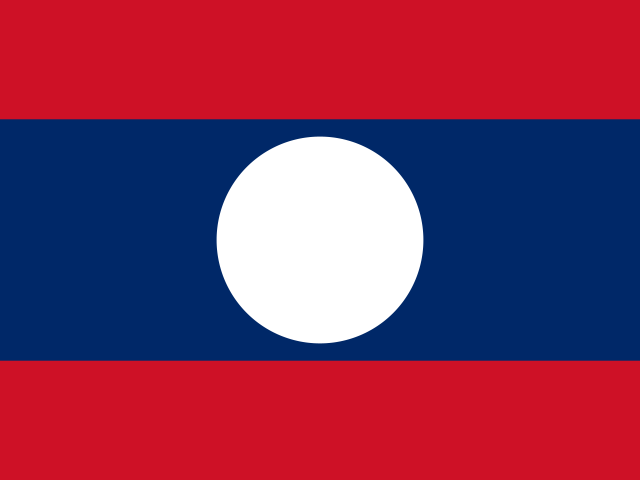 Crime and safety warnings for Laos
Current safety guidance for Laos from UK Foreign Office travel advice. We cover 1 city in Laos, with reported scams for each.
Crime and safety warnings for Laos
Current safety guidance for Laos from UK Foreign Office travel advice. We cover 1 city in Laos, with reported scams for each.