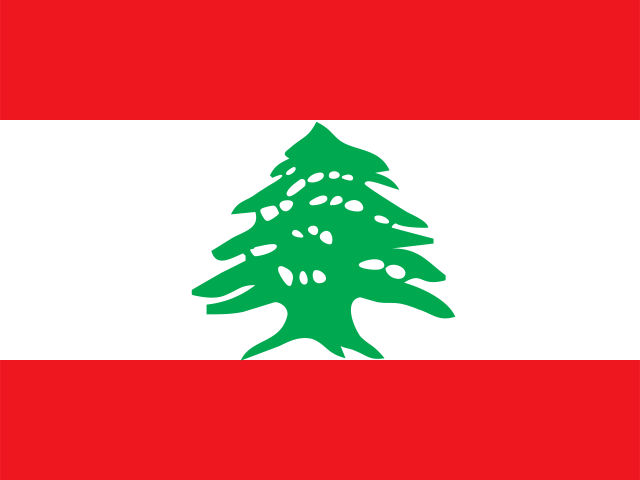
 Lebanon
UK Foreign Office travel advice · 10 August 2026
Current safety guidance for Lebanon from UK Foreign Office travel advice. We cover 1 city in Lebanon, with reported scams for each.
Source: Lebanon travel advice — UK Foreign Office travel advice
Contains public sector information licensed under the Open Government Licence v3.0.
There’s a threat of kidnapping in Lebanon. The Lebanese authorities have warned that foreigners could be targeted.
British nationals are seen as legitimate targets, including tourists, humanitarian aid workers, journalists and business travellers. If you are kidnapped, the reason for your presence is unlikely to protect you or secure your safe release.
The long-standing policy of the British Government is not to make substantive concessions to hostage takers. The British Government considers that paying ransoms and releasing prisoners builds the capability of terrorist groups and finances their activities. This can, in turn, increase the risk of further hostage-taking. The Terrorism Act (2000) makes payments to terrorists illegal.
Criminal gangs involved in drug cultivation and smuggling operate in parts of the Beqaa Valley, especially northern Beqaa. Other armed crimes, such as robbery and kidnap, can occur in these areas. There are also frequent armed clashes between gangs and the security forces.
Do not use shared taxis or taxis hailed on the street. In 2017, the Lebanese Interior Minister advised people in Lebanon not to use Uber taxis.
Only use taxis:
There have been armed robberies and physical attacks against passengers in shared taxis (known locally as service taxis) with passengers being attacked by either the driver or other passengers.
There is a high threat of terrorist attack globally affecting UK interests and British nationals, including from groups and individuals who view the UK and British nationals as targets. Stay aware of your surroundings at all times.
UK Counter Terrorism Policing has information and advice on staying safe abroad and what to do in the event of a terrorist attack. Find out how to reduce your risk from terrorism while abroad.
Terrorists are likely to try to carry out attacks in Lebanon.
Islamist terrorist groups seek to target the Lebanese state, security services, and civilians, and intend to target foreigners in Lebanon. Groups within Lebanon, including Lebanese Hizballah, are proscribed under the Terrorism Act 2000 and the Counter Terrorism (Sanctions) (EU Exit) Regulations 2019. Offences committed under the act – including funding and supporting proscribed organisations – may be liable to prosecution in the UK.
Terrorist groups have particularly operated in:
Recent terrorist-related incidents include a firearm attack which targeted the US embassy in 2024:
There is a heightened risk of terrorism against aviation. Additional security measures have been in place on flights departing from Lebanon to the UK since March 2017. You should co-operate fully with security officials.
If you notice or suspect a security incident is underway, leave the area immediately. Suspects have detonated explosives to avoid arrest. Keep clear of affected areas immediately after any attacks.
The security situation in Lebanon is volatile and can deteriorate quickly.
Violence may occur:
Confrontations often happen without warning and can result in large numbers of casualties. Security forces may use tear gas and rubber bullets during clashes.
Weapons are common in Lebanon and groups such as Lebanese Hizballah have arms that are beyond state control. Arguments can quickly escalate into violence, including the use of weapons, typically firearms and bladed weapons.
Celebratory gunfire is illegal in Lebanon but remains widespread. Every year there are reported casualties.
Regional and international developments such as in Iran, Israel, Syria and Iraq can have an impact on the local security situation. Monitor the regional situation whilst in Lebanon.
You should:
If there are widespread disturbances or the security situation deteriorates, there may be limits to the assistance that the British Embassy Beirut can provide. Be prepared to shelter in place for several days, if the security situation requires it. This means having enough essential supplies, such as food, water and medicine, at the place where you are staying. Do not rely on the FCDO being able to evacuate you in an emergency.
Read FCDO advice on what to do if you’re affected by a crisis abroad and how to prepare.
Lebanon is experiencing a prolonged economic crisis. This may affect your ability to pay for goods and services by credit or debit card. US dollars are widely accepted and are the main cash currency, including in most supermarkets, restaurants and other retail outlets. It may be difficult or expensive to access US dollars locally and many companies do not accept credit/debit cards. Plan accordingly and ensure you have access to adequate cash for the length of your stay.
Lebanon’s power plants are only producing limited electricity for the national grid. This can lead to power cuts. Many businesses rely heavily on generators for electricity, and electricity provision can vary. Have a torch to hand at night and plan how you would leave your accommodation in the dark.
There is moderate risk to tourists from petty or violent crime. Take sensible precautions to protect yourself and your belongings:
There have been reported incidents of sexual harassment and assault in public areas. Consider whether it is safe to walk alone, particularly in less busy areas. Due to the lack of electricity, streetlights often do not work, so streets can be dark at night. Consider taking a torch with you at night and make sure your phone is charged in case of an emergency.
Avoid photography in Lebanese Hizballah areas, including the southern suburbs of Beirut, the Beqaa Valley and areas in southern Lebanon. You may be detained if you are observed taking photographs.
Only take photographs in tourist sites. You could be arrested for photographing military sites. Flying drone cameras without permission is illegal.
Ramadan is a holy month for Muslims. The dates vary by year and country. During this time, be aware of:
Get more advice when you arrive from your tour guide, hotel or business contacts.
You should also:
Lebanon’s people are diverse, with many different Muslim and Christian sects represented. Respect local traditions, customs, laws and religions at all times and make sure your actions do not offend.
In many areas you will find dress codes more relaxed than in other countries of the region, but you should still dress modestly when visiting religious sites.
Possessing, using and trafficking illegal drugs (including small quantities) are all serious offences, punishable with prison sentences.
The Lebanese Criminal Code includes a general provision concerning ‘every sexual act against nature’. Lebanese courts might consider that this includes same sex sexual activity. A criminal offence under this provision is punishable by a prison sentence of up to a year. The Lebanese Medical Association for Sexual Health has resources for LGBT+ people.
Read more advice for LGBT+ travellers.
If you have concerns about child custody, get legal advice before travelling to Lebanon about ‘travel bans’ that can be imposed by male heads of family. Even if you or your child holds a British passport you may be subject to Lebanese laws and regulations.
In Lebanon a father or husband can legally arrange for a travel ban to be placed on their wife or children. If a travel ban is placed on you or your children, you will not be able to travel. If that does happen a parent should seek legal assistance to check if the travel ban can be lifted.
Lebanese family law is very different from UK law and particular care is needed if child custody becomes an issue.
If you’re a British national involved in international parental child abductions or custody disputes, contact the Foreign, Commonwealth & Development Office (FCDO) for assistance or call +44 (0) 2070 085 000. FCDO has information on international parental child abduction, including how we can help. FCDO strongly advises against attempting to move your child yourself. This may be considered abduction (or ‘re-abduction’). This may be illegal and can put your child at risk.
You need either a 1968 international driving permit (IDP) or a UK driving licence to drive in Lebanon. The 1949 IDP is not accepted anymore. You cannot buy an IDP outside the UK, so get one before you travel.
If you are planning to drive in Lebanon, see information on driving abroad.
Driving standards are poor and the accident rate is high. Traffic lights are often switched off and not always observed. It may be better to hire a car with a driver if you’re inexperienced. You must wear a seat belt (if fitted). Avoid travelling at night outside towns if possible. Cars with diesel engines are banned.
Carry ID with you at all times and be prepared to stop at checkpoints to show your papers. The army has set up checkpoints on major and minor roads.
Temporary local licences are also available, but they take longer to get and are more expensive than an IDP.
Protests and roadblocks may restrict travel at short notice. Major roads in and out of Beirut and across the country, including the roads to and from Beirut Rafik Hariri International Airport, have become blocked at short notice. If you’re travelling to or from the airport, check your flight status before leaving and allow extra time for your journey. If roads from the airport are blocked, wait there until the authorities confirm access roads are open.
Landmines and other unexploded weapons are present in Lebanon and are not always clearly marked. Use only well-travelled tracks and do not stray from their edges. Avoid remote abandoned properties. Use local guides and seek local knowledge if you are unsure.
Find out what you can do to prepare for and respond to extreme weather and natural hazards.
There is a heightened risk of forest fires in Lebanon, particularly during summer. Forest fires are highly dangerous and unpredictable. Take care when visiting or driving through woodland areas. The authorities may evacuate areas and close roads for safety.
If you are travelling in Lebanon, familiarise yourself with local safety and emergency procedures, stay vigilant, and follow the advice of local authorities.
For information on the risk of forest fires, visit the Disaster Risk Management website, Facebook page and X account.
If you see a forest fire, call the emergency services on 112 (for the fire service, call 175).
Lebanon is in an earthquake zone. There have been no damaging tremors in recent years, although Lebanon experienced strong aftershocks from an earthquake in Turkey in February 2023. The US Federal Emergency Management Agency has advice about what to do before, during and after an earthquake.
This section has safety advice for regions of Lebanon. It only covers regions where FCDO has specific advice.
You should also read FCDO’s overall travel advice and safety and security advice.
FCDO advises against all travel to the southern suburbs of Beirut due to the presence of armed groups and heightened risk of organised crime including kidnapping.
Weapons are common in these areas and groups such as Lebanese Hizballah have arms that are beyond state control. There have been Israeli airstrikes in the southern suburbs of Beirut in 2026. Future airstrikes cannot be ruled out.
Since 2023, there has been frequent artillery fire and airstrikes in Lebanon, particularly in the South and Nabatiyeh Governorates. There is a risk of further strikes in the area.
There is a UN peacekeeping presence in the area south of the Litani River due to tensions between Lebanon and Israel.
The Israeli Defence Forces currently retain a presence in southern Lebanon . British Nationals should be aware that Israeli Defences Forces have fired at civilians who have ignored their instructions to leave these areas.
See Conflict affecting Lebanon for further information.
FCDO advises against all travel and all but essential travel to areas in the Beqaa Governorate (as described in ‘Warnings and insurance’ page) due to risks from Israeli airstrikes and criminal activity in these areas.
Since 2024, there have been several Israeli airstrikes in the Beqaa Valley. There is a risk of further strikes in the area.
There have also been Israeli airstrikes in Baalbek-Hermel Governorate, including the town of Baalbek.
In addition, British nationals should be vigilant to heightened risks from criminal activity in the Baalbek-Hermel Governorate. Since 2025, there have been several instances of deadly armed clashes between Lebanese and Syrian groups in border towns near Hermel. Further clashes cannot be ruled out.
The Lebanese Armed Forces have conducted raids against narcotics factories in Baalbek, resulting in the death of numerous soldiers. Since 2024, there have been airstrikes close to the highway and near to the border with Syria. Further strikes cannot be ruled out in this area.
FCDO advises against all travel to the 12 Palestinian refugee camps. See Palestinian refugee camp locations on the UN Relief and Works Agency website.
Palestinian refugee camps are volatile environments where the Lebanese state has limited capacity to impose law and order. There has been a long pattern of violent clashes.
In September 2023, Ain el Hilweh camp witnessed intense violence resulting in a number of casualties. There were reports of bullets reaching as far as Ghaziyeh Town (2km south). The situation remains volatile and tensions could escalate without warning. There have been Israeli airstrikes on Palestinian refugee camps, including strikes on Ain el Hilweh camp in November 2025, February 2026 and March 2026, which resulted in casualties.
FCDO advises against all travel to the area of Akkar Governate close to the Syrian border due to the unstable security situation in Syria.
FCDO advises against all but essential travel to some areas of the city of Tripoli due to the risk of criminality, localised armed disputes, and public disorder.
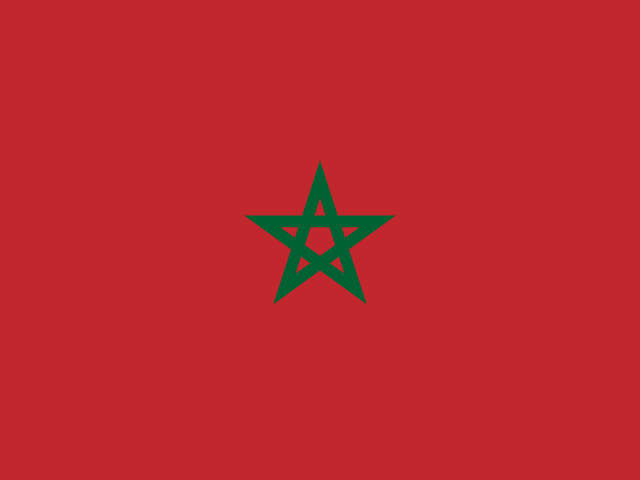 Crime and safety warnings for Morocco
Current safety guidance for Morocco from UK Foreign Office travel advice. We cover 2 cities in Morocco, with reported scams for each.
Crime and safety warnings for Morocco
Current safety guidance for Morocco from UK Foreign Office travel advice. We cover 2 cities in Morocco, with reported scams for each.
 Crime and safety warnings for Nigeria
Current safety guidance for Nigeria from UK Foreign Office travel advice. We cover 1 city in Nigeria, with reported scams for each.
Crime and safety warnings for Nigeria
Current safety guidance for Nigeria from UK Foreign Office travel advice. We cover 1 city in Nigeria, with reported scams for each.
 Panama is at Level 2: exercise increased caution
Current safety guidance for Panama from US State Department travel advisories. We cover 1 city in Panama, with reported scams for each.
Panama is at Level 2: exercise increased caution
Current safety guidance for Panama from US State Department travel advisories. We cover 1 city in Panama, with reported scams for each.
 Crime and safety warnings for Colombia
Current safety guidance for Colombia from UK Foreign Office travel advice. We cover 3 cities in Colombia, with reported scams for each.
Crime and safety warnings for Colombia
Current safety guidance for Colombia from UK Foreign Office travel advice. We cover 3 cities in Colombia, with reported scams for each.
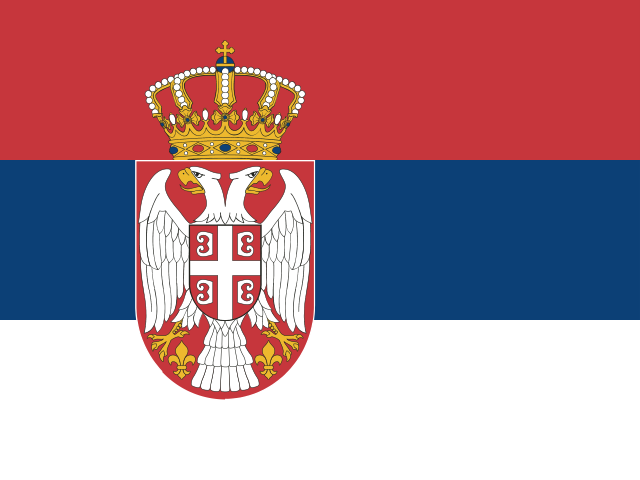 Crime and safety warnings for Serbia
Current safety guidance for Serbia from UK Foreign Office travel advice. We cover 1 city in Serbia, with reported scams for each.
Crime and safety warnings for Serbia
Current safety guidance for Serbia from UK Foreign Office travel advice. We cover 1 city in Serbia, with reported scams for each.
 Crime and safety warnings for Laos
Current safety guidance for Laos from UK Foreign Office travel advice. We cover 1 city in Laos, with reported scams for each.
Crime and safety warnings for Laos
Current safety guidance for Laos from UK Foreign Office travel advice. We cover 1 city in Laos, with reported scams for each.